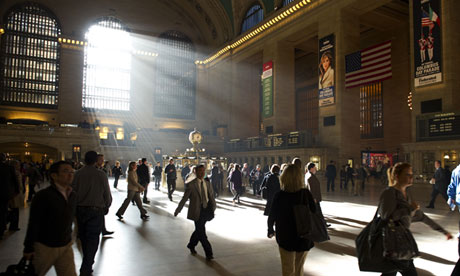
Commuters make their way through Grand Central Terminal, in New York. Photograph: Don Emmert/AFP/Getty Images
This week it was announced that relief may finally come to
long-suffering New York rail commuters, with the news that the lease for
Madison Square Garden, which since 1968 has crushed Pennsylvania
Station underfoot, has been renewed only for 10 years. The city council
now has the chance to right the calamitous wrong that was perpetrated by
the destruction of the old Penn Station, by coming up with plans to
replace the Garden with a new structure.
Our earlier post on the ugliness of New Penn, and
other stations around the world, brought calls for a more positive
outlook on railway stations. Here, then, is a celebration of 10 of the
world's finest.
Grand Central Terminal, New York
In the late 1960s, the finest railway station in America nearly
suffered the same fate as the old Penn Station, when developers
attempted to replace the Beaux-Arts terminal with an office building.
But Grand Central, thanks in large part to a campaign by Jackie Kennedy,
survived – and is looking better than ever in this its 100th
anniversary year. With its Tiffany clock on the south facade and its
spiffed-up zodiac mural in the central concourse, it's a tourist
destination in its own right and one of the rare stations worth
lingering in for a meal or a drink. The oldest establishment in the
station is the Grand Central Oyster Bar, on the lower level; the
bivalves there are all right, yes, but the martinis upstairs at the
Campbell Apartment bar are even finer. One knock against Grand Central:
the incongruous, disruptive Apple Store that has taken up residence on
the eastern staircase.
Union Station, Chicago
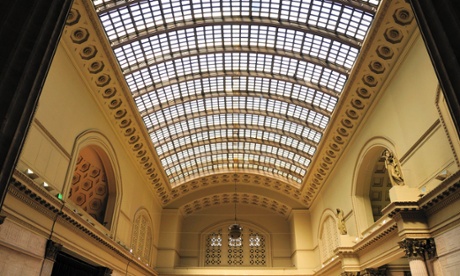
Waiting room and interior of Union Station, Chicago, Illinois. Photograph: Bruce Leighty/Getty Images
Arriving at Union Station transports you back to Chicago in the
1920s, when the Second City was building some of the most
architecturally ambitious projects anywhere in the world. Now the
third-busiest station in the country, Union Station is a riot of marble
and glass that soars more than 100ft into the air. The soaring, skylit
Great Hall is a fantastic place to wait for a train. Unfortunately, the
train you'll be getting on will probably be a rundown Amtrak job.
Atocha station, Madrid
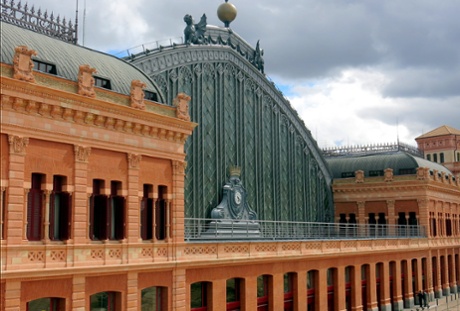
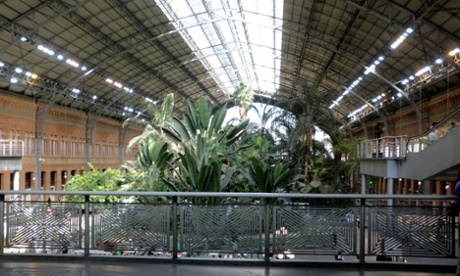
The exterior of Atocha station in Madrid. Photograph: Manuel Martín Vicente/FlickrThe interior of Atocha station in Madrid. Photograph: Emilio J. Rodríguez-Posada/flickr
Like many 19th-century railway stations in European capitals,
Atocha was built in a wrought-iron style, with the platforms lit through massive skylights. (Gustave Eiffel collaborated on the design.) But what makes Atocha stand out today is something else: after a successful modern addition in the 1990s, the old section has been converted into a massive botanical garden, where passengers waiting for trains can see more than 260 varieties of plants under the vaulted ceiling. There are even turtles!
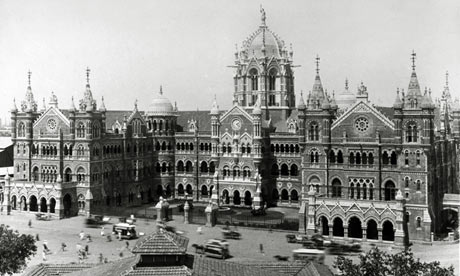
Chhatrapati Shivaji Terminus, Mumbai
The magnificent
Victoria Railway Station, Bombay is now known as the Chhatrapati
Shivaji Terminus, Mumbai. Photograph: Popperfoto/Getty Images
The former Victoria Terminus in the former Bombay was built in
1887 and is now the busiest station in India. It's certainly hectic,
but the thrilling combination of Victorian Gothic and Mughal styles is
a feat of imagination as much as engineering. VT, as some locals
still call it, was the site of one of Mumbai's 2008 terror attacks.
Much more happily, it was also the scene for the grand finale of
Slumdog Millionaire. It has Unesco World Heritage Site designation.
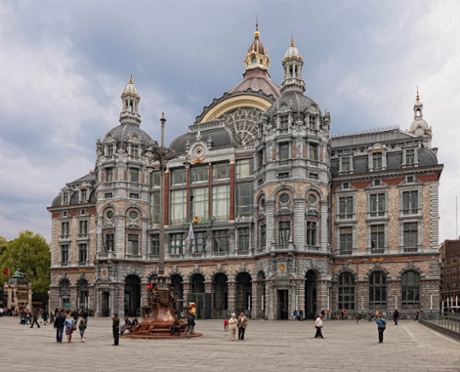
Antwerp Central
Antwerp Central railway station. Photograph: Juergen Ritterbach/Getty Images
Inspired partly by the Pantheon in Rome, the main railway station
of the Flemish capital is closer to a palace than a transportation
hub. It's obscenely extravagant – featuring 20 different kinds of
marble. In fact, it's hard to look at all its lavishness and not be
reminded of what paid for it: Belgium's horrific colonial enterprise.
But as WG Sebald wrote in Austerlitz, a novel set partly at
Antwerpen Centraal, "when we step into the entrance hall we are seized
by a sense of being beyond the profane, in a cathedral consecrated
to international traffic and trade".
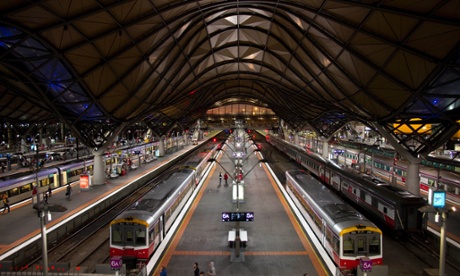
Southern Cross Station, Melbourne
Southern Cross Station on Spencer Street, Melbourne Photograph: Kylie Mclaughlin/Getty Images/Lonely Planet Image
Melbourne's transport hub, which until 2005 was known as Spencer
Street Station, used to consist of some shabby concrete structures that
barely joined up. It has now been unified under a new undulating roof
that covers an entire city block. The roof keeps the station cool in the
long Victorian summers, and it also allows fumes from the trains to
escape through perforations cut in the top.
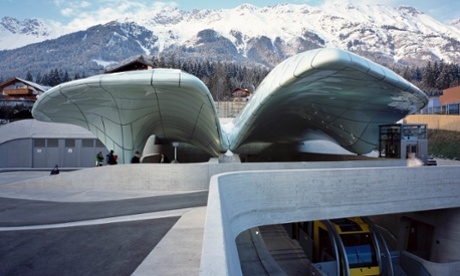
Hungerburgbahn stations, Innsbruck
One of the Hungerburgbahn stations, Innsbruck. Photograph: Markus Bstieler/View
They service only a 1.8-km funicular track, but the four
swooping stations that Zaha Hadid designed for this Austrian alpine town
are the most aesthetically ambitious rail stations of the 21st
century. Each of the stations features the British-Iraqi architect's
signature fluid forms, inspired by glaciers and ice formations.
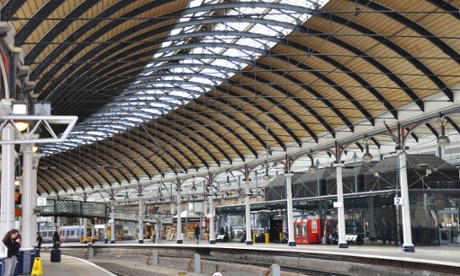
Newcastle Central
Newcastle-upon-Tyne railway station. Photograph: Grazyna Bonati/Getty Images/Gallo Images
Britain has no shortage of impressive railway stations, from
the renovated St Pancras in London to the elegantly industrial York. But
no British hub has the civic force of Newcastle's main station, with
its neoclassical facade and train shed comprising three arched spans. It
could definitely use a little scrub-up, and like most British stations
it desperately needs a better newsstand. But it's still a delight to
see, recalling the glories of an earlier era of rail travel. The exterior of St Pancras station, London
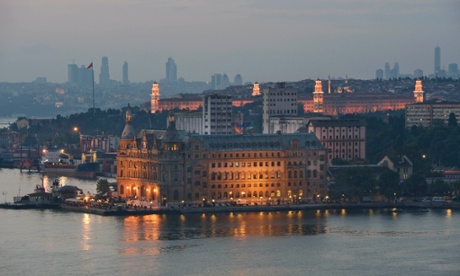
Haydarpasa Terminal, Istanbul
The Haydarpasa Terminal, Istanbul Photograph: Izzet Keribar/Getty Images/Lonely Planet Image
Western Europeans may be more familiar with Sirkeci Terminal, the
end of the line for the Orient Express. But Istanbul's more
impressive station, a castle-like affair surrounded on three sides by
water, is on the other side of the Bosphorus. Its future is uncertain,
however. Damaged by fire in 2010, the station is currently closed.
Although there had been plans for Haydarpasa to serve as the terminus
for high-speed trains to Ankara, it may end up as a hotel or
shopping center.
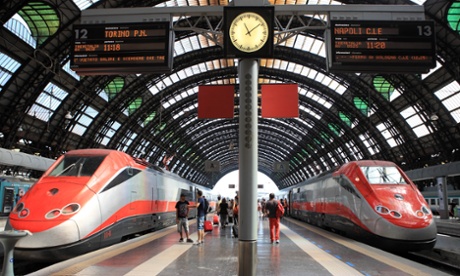
Milano Centrale
Milan central station. Photograph: Vincenzo Lombardo/Getty Images
We all know the stupid excuse for fascism: at least Mussolini made
the trains run on time. That was a myth – but Milan's monumental
central station is real, and its problematically beautiful combination
of neoclassical and Art Deco styles still packs a punch. The train shed
is a tremendous steel structure, joined up to a gargantuan
marble station, 200m wide with motifs scrolls and eagles' wings
fixed into the walls.
 Email
Email


No comments:
Post a Comment